Entertainment
Health
leg curl machine, leg extension, leg extension machine alternative, leg extension machine benefits, leg extension machine exercise, leg extension machine in pakistan, leg extension machine muscles worked, leg extension machine pakistan, leg extension machine price, leg extension machine price in pakistan, leg extension machine technogym, leg press machine
Admin
0 Comments
The Power and Precision of the Leg Extension Machine
Imagine stepping into a gym. The hum of treadmills vibrates through the floor, weights clink, trainers shout encouragement. In a corner, quietly and almost unassumingly, sits the sleek frame of the leg‐extension machine. Many glance at it, perhaps skip past it in favor of squats or leg presses. But what if that machine holds a special key a unique opportunity to sculpt, strengthen, and isolate one of the most important muscle groups in the body: the quadriceps?
This is the story of the leg extension machine: how it arrived, how it works, why it matters, how you can use it smartly, and when you might hold back. By the time you finish reading, you’ll understand not just how to use this machine, but why and when. Let’s begin.
What Is the Leg Extension Machine?
At its core, the leg extension machine is a piece of resistance‐training equipment designed to isolate the knee‐extension movement. With a seated or slightly reclined position, you position your shins under a padded lever and extend your legs until they’re nearly straight, then return them under control. In effect, you’re training your quadriceps femoris that big front thigh muscle.
But the story runs deeper. The term “leg extension” often refers to the exercise using that machine, and the machine itself dates from decades of strength‐training evolution. The Wikipedia entry notes that the leg extension machine “was created by American fitness guru Jack LaLanne in the 1950s” (with prototypes under Gustav Zander) to specifically target the quadriceps. Wikipedia
Why does the machine matter? Because it gives you the ability to control one joint (the knee), fix the hips, and isolate the muscle action. That highly controlled environment opens opportunities: muscle craft (hypertrophy), rehab (targeted strength rebuild,) and even performance tuning.
Why Use It? The Case for the Leg Extension
Isolation, control, and specificity
Many lower-body exercises are compound: squats, lunges, and leg presses all involve multiple joints, hip extension, balance, and stabilization. In contrast, the leg extension is a mono‐articular movement (knee extension only). That means you can dial in on your quads with much less interference from glutes, hamstrings, or hip flexors.
As one fitness review puts it: “One major benefit to the leg extension is that you can control the movement and focus on your quads. That means you can move with intent…” Men’s Health
Research confirming unique value
The science backs this up. A study comparing exercise selection for regional muscle hypertrophy found that when participants used the leg extension, all three regions of the rectus femoris (a quadriceps head) grew significantly, whereas using the squat in the Smith machine only produced growth in one region of the vastus lateralis. PubMed
Another study compared the squat vs leg extension: the leg extension group saw statistically significant growth in their rectus femoris at all measurement sites, whereas the squat group did not. StrengthLog
In short, if your goal is to build the quads in a targeted way, especially the rectus femoris, the leg extension machine offers a deliberate advantage.
Rehabilitation and injury-friendly usage
Because the machine stabilizes you (you’re seated, arms holding handles, back supported), it’s often used in rehab scenarios. A review of ‘smart’ leg extension machines in rehabilitation noted that such devices “significantly minimize the disadvantages of conventional heavy machines for fitness or rehabilitation.” PMC
So if you’re recovering from a knee injury, or if balance and joint stability are concerns, the machine offers a safer route to rebuilding quad strength.
Strategic tool in training
Beyond pure isolation, the leg extension can play smart roles in programming. For example, one practitioner recommends using leg extensions before leg presses (a “pre-exhaust” technique) so that the quad is fatigued, forcing the leg press to recruit more efficiently at lighter loads a valuable trick when heavier free-weight work isn’t feasible. discoverstrength.com
Biomechanics: How It Works
To appreciate when and how to use the leg extension machine, we must understand what’s happening under the hood: muscle forces, joint angles, and mechanical load.
Joint loads and angles
A landmark study on knee‐extension biomechanics found that “very large quadriceps forces are required to accomplish the last 15 degrees of extension … typically twice those required to reach 30 degrees of flexion.” PubMed
What does that mean for you? As your shin lever approaches full extension, the quad must generate significantly higher force to complete the movement. Consequently, proper form, progression, and caution are key.
Muscle heads and why it matters
The quadriceps around your thigh aren’t all identical. There’s:
- Vastus lateralis
- Vastus medialis
- Vastus intermedius
- Rectus femoris (bi-articular: crosses hip and knee)
Because the rectus femoris crosses both the hip and knee, its function depends on both joints. In many compound leg exercises (squat, leg-press) where both hip and knee move, the rectus femoris may not be fully engaged. The leg extension machine fixes the hip and lets the knee do the work — meaning higher rectus femoris activation in many cases. StrengthLog+1
The effect of hip angle
An interesting controlled study compared hip flexion angles: training at 90° hip flexion versus 40° (when doing leg extensions) found greater hypertrophy in the rectus femoris for the 40° condition. PubMed+1
Implication: if you change how far your seat tilts (altering hip angle), you can shift which portions of the quad get emphasized.
How to Use the Leg Extension Machine — and When
Setup & execution: step-by-step
According to a detailed guide: BarBend
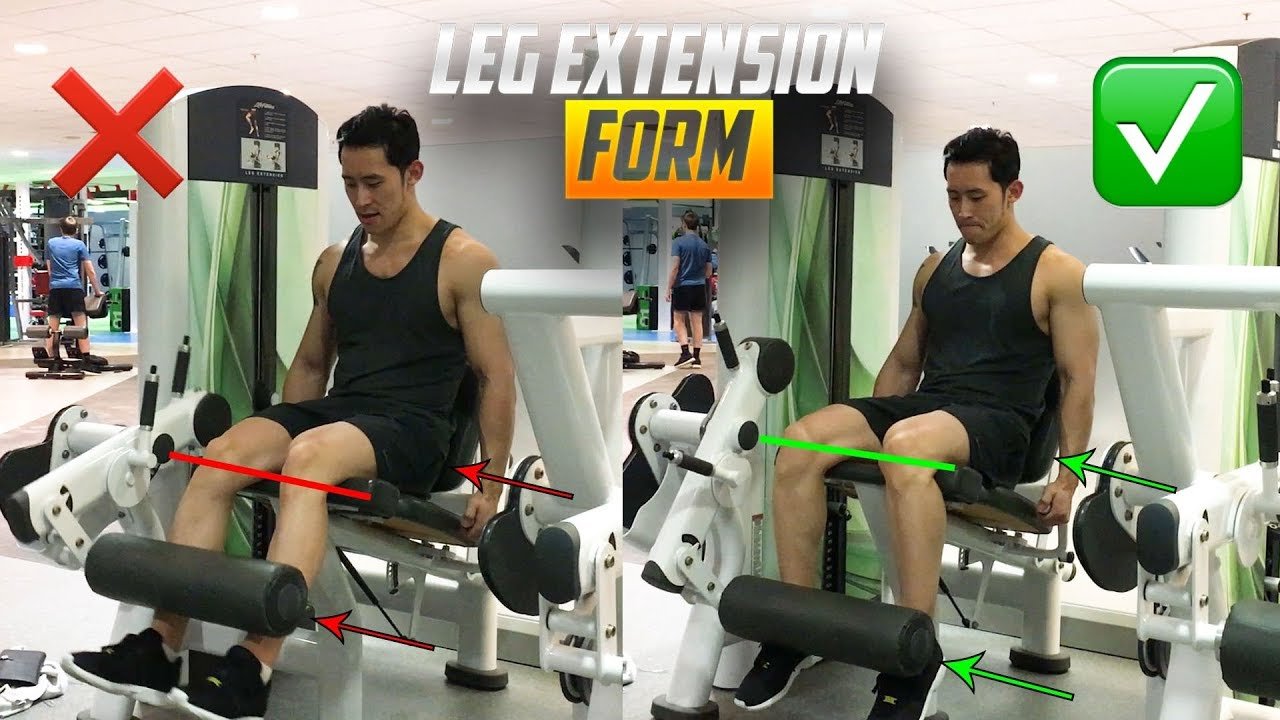
- Adjust the seat so your knees align with the machine’s pivot, and your shins are behind the pad comfortably at about 90° knee flexion.
- Sit tall, back pressed into the pad, hold the handles. Retract your head (don’t tilt forward), shoulder blades down and back, navel drawn toward the spine. Maintain a neutral spine (no arching).
- Extend the legs with control drive through the quads, pause briefly at the top (without locking the knees aggressively), then let your legs return under control (the eccentric).
- Emphasize control on the descent phase. Many skip that and let the pad drop quickly, but hypertrophy research suggests the eccentric (lengthening) portion is critical. BarBend
- Use a full but safe range of motion: from ~90° knee flexion up to 10-15° shy of full locked extension (to avoid excessive joint stress).
Programming advice
- Sets & reps: For hypertrophy, typical ranges: 3-4 sets of 8-15 reps.
- Tempo: Consider slower eccentric (2-3 seconds down) and a brief pause at the top before returning.
- Variations: Adjust seat incline (hip angle) to shift emphasis toward rectus femoris or vasti. Use lighter weight and higher reps for endurance or rehab; heavier weight and lower reps for strength, but ensure form remains controlled.
- Pairing strategy: Use leg extensions early in your workout (pre-exhaust) or as a finisher later, depending on your goals. For example, do leg extensions before leg presses to pre-fatigue, or after squats/presses to target the quads cleanly.
Technique tips and caution
- Avoid momentum swings — don’t let the pad slam back or yank through the motion.
- Keep your spine stable — no arching or sliding forward.
- Don’t lock out your knees violently at the top — that can increase joint stress.
- If you feel knee pain (especially patellofemoral pain), reduce the range of motion or weight, and emphasize control.
- Adjust the pad so it’s just above the ankles (on the shin lever). Placement affects leverage and joint stress.
Benefits, Pitfalls, and Practical Insights
Real‐world advantages
- Targeted hypertrophy: As the research shows, for building the rectus femoris and specific portions of the quad, the leg extension machine is highly effective. StrengthLog+1
- Rehab utility: Because of controlled load and isolation, this machine can rebuild quad strength without overloading the hips or requiring complex balance.
- Training flexibility: It works for beginners who may not squat yet, for athletes seeking quad finishers, or for advanced lifters seeking precise quad development.
- Pre-exhaust technique: Using the machine before heavier multi‐joint lifts can improve exercise efficiency. discoverstrength.com
Limitations and caveats
- Transfer to sport/function: Because it’s an open-chain exercise (the foot is not fixed, the body is seated), its carryover to functional movements (running, jumping, multi-joint leg work) may be less than that of squats or leg presses. Some studies show compound exercises offer better carryover to performance metrics (jump height, etc.). Lippincott Journals
- Joint stress if poorly performed: Because the machine concentrates load around the knee, bad technique or excessive range/weight can increase patellofemoral stress. The wiki entry warns of this. Wikipedia
- Over-reliance pitfall: Using leg extensions exclusively and neglecting compound leg work may lead to imbalances — stronger isolated quads but weaker glutes, hamstrings, or hip control. Balanced programming remains essential.
Case study: quad imbalance addressed
Imagine an amateur athlete, Sarah, who had a minor ACL reconstruction and found that her quadriceps strength lagged. Under her physical therapist’s guidance, she started using the leg extension machine with light load, high reps (3 sets × 15 reps) twice per week, focusing purely on the eccentric return and range stopping 20° shy of full extension (to reduce joint stress). Over 12 weeks, she progressively increased weight, maintained control, and by week 8 was cleared to add closed-chain leg press work. Her quad strength improved measurably, she regained symmetry, and she later reintegrated squats and plyometrics. The leg extension machine offered a safe, targeted bridge between rehab and full function.
Advanced Strategies for Maximizing Impact
Variations and tweaks
- Seat-angle adjustment: Reducing hip flexion (e.g., tilt the seat back so your hip is closer to 40° instead of 90°) emphasizes rectus femoris hypertrophy. PubMed+1
- Rep‐tempo manipulation: Use slow 3-4 s eccentrics, holds at full extension (1-2s), faster return for force development, then control down again.
- Partial‐range focus: In rehab or hypertrophy phases, you might limit range (say 0-60°) or do “top half” to reduce knee torque but keep tension. Some research suggests partial ranges still produce effective growth. PubMed
- Pre-exhaust or cluster sets: Use 2 sets of leg extensions before compound lifts, or cluster sets (short rest mid-set) to maintain higher volume under fatigue.
- Unilateral work: Using one leg at a time reveals imbalances and forces core stability.
- Mind-muscle focus: Because you aren’t stabilizing a barbell or balancing your torso, you can purposely feel the quads working, especially through the contraction and the eccentric.
Integrating into a full leg program
You need balance. Here’s one sample structure:
- Warm-up: bodyweight squat, hip hinges
- Compound lift: Barbell back squat or leg press (3-5 sets)
- Accessory: Leg extension machine (3-4 sets × 8-15 reps) with controlled eccentric
- Hamstring/glute emphasis: Romanian deadlift or hamstring curl
- Finisher/core: Walking lunges or Bulgarian split squats
- Dial in one compound, one isolation (leg extension), one antagonist movement (hamstrings/glutes) that gives balance.
When to emphasize the leg extension
- When you need quad isolation (e.g., physique goals: front thigh sweep)
- When you are rehabbing a knee, and free-weight training is currently limited
- When you are in a “leg finish” phase of a workout and want to burn out the quads
- When you have quad strength deficits compared to other muscles (say your glutes are carrying most of the load, and your quads lag)
When to de-emphasize it
- If your goal is purely athletic transfer (jumping, sprinting) and you have very limited gym time, compound lifts will offer more bang-for-buck.
- If your knees feel cranky during leg extensions, reduce the range, lighten the load, or avoid until your mobility and strength improve.
- If you neglect the posterior chain, quads are important, but so are glutes, hamstrings, calves, and hips.
Real-Life Example: From Guy Who “Hated” Leg Extensions to Quad Growth
Take John, a 34-year-old fitness enthusiast. He had focused on deadlifts and squats for years and found his front thigh development always lagged behind his glutes and hamstrings. He looked great from the back, but the side profile exposed that his quads lacked fullness. He decided to give the leg extension machine a proper chance.
The first week, he started with 3 sets of 12 reps at moderate weight, focusing purely on the contraction, no swinging, slow descent. By week 4, he bumped to 4 sets × 10 reps and experimented with seat tilt (lowering his hip angle). By week 8, he added some unilateral leg extensions (one leg at a time) and slowed the eccentric further (4-s descent). By week 12, paired with his usual squats and presses, his quad sweep was visibly improved, his knees felt stronger, and his overall leg symmetry improved. The machine that used to feel like a “boring isolation option” became a meaningful component of his leg development.
Addressing Common Concerns & Myths
“Leg extensions will destroy my knees.”
The fear is not entirely unfounded because the movement isolates the knee, maximal joint loads can be high, especially at lockout. But the solution is not to avoid the machine, it’s to use it smartly: controlled range, correct pad/seat alignment, appropriate load, and progressive programming. Many rehab protocols use leg extensions safely when approached carefully.
“Squats alone are enough. Why bother with leg extensions?”
Squats are fantastic they train multiple joints, build strength, and transfer to performance. But they may not fully engage the rectus femoris or specific regions of the quad in the way a machine can. The research shows that the leg extension induced growth, where squats alone did not. StrengthLog+1
“Machines replace free weights now?”
No. The leg extension machine is a tool, a purposeful one, not a replacement for compound lifts. The best programs often include both machine‐based and free‐weight work. A recent meta-analysis found no significant difference in hypertrophy when comparing machine-based vs free‐weight training, broadly meaning machines can be just as good if used well. BioMed Central
FAQ: Frequently Asked Questions
Q1: How often should I use the leg extension machine?
A1: For hypertrophy, 2-3 times per week per muscle group is reasonable. If you’re doing full leg workouts twice weekly, one or two sets of leg extension per session may suffice. Adjust based on recovery, soreness, and other lower-body volume.
Q2: How heavy should I go on the machine?
>> A2: Use a weight that allows you to cleanly complete your target reps (say 8-15) with good form and full control, especially on the eccentric phase. Heavier loads are okay for strength phases, but don’t sacrifice power for weight.
Q3: Should I go to full leg lockout?
A3: Not always. Many training protocols stop short of full lockout (say 10-15° before full extension) to reduce joint stress and maintain quad tension. You can vary: sometimes full extension for hypertrophy, other times partial range for rehab or control.
Q4: Is the leg extension machine suitable for beginners?
A4: Yes, especially as an introduction to quad isolation when balance or technique for squats is still developing. However, ensure the seat/pad setup is correct and you understand how to control the motion.
Q5: How do I pair it with compound lifts?
>> A5: One effective structure: start your leg session with compound lifts (squat/leg press) when you’re fresh; follow with leg extensions to finish the quads. Alternatively, use leg extensions first (pre-exhaust) when your goal is quad activation and you plan lighter compound work.
Conclusion
The leg extension machine may not be flashy like the barbell squat or the Olympic lift. It lacks the spectacle. Yet beneath its simplicity lies real power: the ability to isolate the quadriceps, fine-tune muscle development, assist rehab, and enhance complete leg programming. The science confirms that the leg extension offers distinct benefits for quad region growth, particularly the rectus femoris, which many compound lifts alone may not achieve.














Post Comment